Proposals for forest technologies
The following research and policy recommendations offer strategies to enable community-led approaches to smart forest technologies to be effectively designed, implemented, and supported. We consider how smart forest technologies can be more equitable through sustainable design, use, support and funding. We propose ways to look beyond digital technologies alone and embrace a plurality of forest techniques and technologies, including those that are analogue, ancestral and ecological.
These recommendations have been drawn from our interviews and research with case study communities, together with our reviews of existing literature, practices, technologies, and policy. Our intention is to compose suggestions that are relevant to a broad range of actors in the field of forest technologies, including communities, CSOs, publics, NGOs, funders, technologists, industry actors, researchers, and policymakers.
1. Pluralise engagements with forest technologies to integrate community knowledge
Our research indicates a need for technologies—digital and otherwise—to operate alongside other forms of knowing and inhabiting forests. These technologies should not be considered mere ‘objective’ digital reflections of ecosystems. Instead, they should be engaged with as tools to complement environmental knowledge and experience, contributing to and complexifying existing ways of sensing and inhabiting forests.
Digital forest technologies risk overshadowing community ways of knowing and reducing complex forest worlds to remote mapped observations, or monetisable data on carbon or species. This could lead to the neglect of other less detectable species, cultures, histories and ecological functions. Older generations may be particularly vulnerable, as they are generally less engaged with digital infrastructures, making their perspectives more likely to be overlooked.
Community-led forest technology initiatives should work consciously to incorporate ancestral and local knowledge, as well as differing social-political perspectives, in the design and deployment of technologies. In order to pluralise ways of knowing and inhabiting smart forest worlds, we recommend integrating digital, analogue and ancestral methods when working with community-led forest technologies.
For example, during our Field Schools in Uttarakhand, researchers and participants combined participatory paper mapping of village territories with GPS mapping. Participants also used video footage to narrate community experiences on the ground and complicate the narrative produced by drone footage. Meanwhile, during Field Schools in Ecodorp Boekel, researchers constructed an interactive installation featuring playful QR-code scanning to stimulate community conversations about biodiversity. These conversations highlighted the importance of acknowledging biases in technology design and data.
Understandings and experiences of forest worlds can be pluralised by fostering interdisciplinary and experimental collaborations. For example, artists and scientists in Chile worked together to produce fire narratives that creatively influenced discussions and ideas for community fire prevention plans and networks. By incorporating cultural engagements with fire, it is possible for more connected and viable education and prevention plans to be composed. Moreover, some Smart Forest Field Schools encouraged ‘moral imagining’, which involves considering environmental challenges from the perspective of ancestors, future generations and ‘more-than-human’ entities, thereby complicating technological narratives focused on more ‘real-time’ objectives.
This proposal to work with and across plural knowledge systems in forest observation and action resonates with our stakeholder workshop held at Kew Gardens, where participants emphasised the need to cultivate open and inclusive data practices and to widen community participation. Participants discussed how to balance data accuracy and quality and what counts as ‘good enough’ data for scalable, actionable outcomes. There was a strong emphasis on integrating varied data types — ecological, social, and geospatial — and recognising forms of knowledge that often remain outside formal data systems. To ensure pluralistic approaches to forests, governments, eNGOs, technology companies, and community initiatives should also prioritise interdisciplinary collaboration across environmental and social sciences to facilitate the development of more useful and inclusive forest technologies.
2. Ensure forest technologies are accessible and distributed to multiple community members while addressing resource limitations within communities
To ensure that smart forest technologies are effectively community-led, it is essential that they are accessible and distributed among multiple community members. As noted in this report, the introduction of smart forest technologies can shift or perpetuate inequalities, including but not limited to gender, class, education, ethnicity, race, religion, and generational dynamics. For this reason, equitable distribution and accessibility are crucial for fostering fair engagements with technology both within and across communities.
Accessibility can be facilitated by a series of levers at different levels of governance. It is important to provide not only the necessary equipment but also education and training on technologies, data privacy, processing, and storage. This approach ensures that communities are not merely treated as data sources. Community leaders and collaborators should also carefully frame smart forest technologies in a way that emphasises their relevance within wider structures and environments, such as land rights, livelihoods, or fire prevention.
Communities should also recognise that cutting-edge technology is not always required to generate effective forest data. For example, across all case studies we found that technologies such as GPS devices, drones, and smartphones are affordable, easy-to-use, and relatively low-tech. Such devices and practices can facilitate community wildfire organising, participatory mapping, biodiversity mapping, and forest patrols.
Finally, policymakers could consider establishing standards for digital forest technologies to be ‘inclusive-by-design’, encouraging and ensuring accessibility for people who may be non-literate. They should also consider addressing resource constraints so that technologies are affordable for community groups.
3. Encourage co-design of diverse forest technologies
To create forest technologies that are useful and usable for communities, researchers and technologists should pursue co-design with communities. Digital tools and infrastructures created by, with and for communities can strengthen communities, increase the impact of community organisations, and promote diverse and sustainable technology systems.
Our research with the Dutch Ecodorp Boekel ecovillage demonstrated how living labs can offer an opportunity for communities to contribute to technology design. Communities can trial technologies on-site and send iterative feedback to identify helpful interventions early in the technology development process. Similarly, during art-science Field Schools in Chile, we found that a more comprehensive understanding of environments and wildfire materialised across multiple perspectives, knowledges and practices.
Our stakeholder workshop at Kew Gardens similarly pointed to the importance of widening community participation through relevant and useful digital tools that are co-designed with communities, especially marginalised groups. Workshop participants emphasised the need to involve communities across data lifecycles, from collection to decision-making.
To connect with and build on these experiences, technologists and researchers should generate research questions that align with the research interests of community members while ensuring their methods are dialogic and iterative by putting community concerns and interests at the centre of development and implementation processes.
4. Mobilise appropriate technologies to connect and strengthen networks
While smart forest technologies can be useful to communities for mapping, monitoring, education, and even planting, these technologies in and of themselves are not hallmarks of thriving forests. Our research found that forest management practices and appropriate technologies that prioritise community needs, knowledge, and voices lay the foundations for flourishing forest worlds. This was particularly apparent on the West Coast of Scotland, where community-led projects centred on citizen engagement and benefits. For example, in Ardura Community Forest, the Biodiversity Officer stressed that they would not deploy deer-fence monitoring devices if this might make local volunteering redundant. Meanwhile, a participant in Appin noted that the best technology was the ‘trained eye’, able to observe the forest as a whole and draw on cultural knowledge.
Moreover, many of the community-led projects in Scotland made visible links between the forest and the community’s well-being. For example, in Ardura, money generated by the forest regeneration site from felling Sitka spruce was deployed in the community where it was most needed. Rather than spending this money on high-tech smart forest devices, finances were channelled into creating community infrastructure and affordable community housing. By linking forest regeneration with community wellbeing, projects can foster integrated understandings of forest health alongside a sense of belonging. While smart forest technologies can be useful to communities, they should be understood as a means to an end, rather than an end in themselves.
Smart forest technologies have wider political impacts, mediating and modulating community engagement with states, private technology companies and broader networks. Our research further suggested that technologies could be used to join up multiple components of environmental monitoring and management so that biodiversity, climate change, water shortages, and environmental hazards are understood as part of interconnected systems.
We also found that technologies can be used to share resources and advance environmental education and communication. In Scotland, we saw that technologies were enabling knowledge-sharing networks and platforms, including the Alliance for Scotland’s Rainforest site, that were contributing to a wider, national movement for rainforest regeneration. In Chile, we saw how education could help prevent wildfire hazards since humans cause the majority of these incidents. In this sense, the cultural aspects of technologies are central to how they might be developed, implemented, and maintained.
5. Ensure community-led forest technology funding, research, and regulation is place-based, ethical, and sustainable
Ethical and sustainable relationships should be developed between communities, funders and researchers working with smart forest technologies. External supporting bodies, such as foundations and NGOs, should offer communities sustainable, bespoke funding, training and engagement. For example, the Indonesian NGO KKI Warsi has made a long-term commitment to the Bujang Raba community. KKI Warsi offers training to community members and field team members who live alongside the community for longer durations. Likewise, legal researchers have worked alongside the Van Gujjar communities in Uttarakhand for a decade. In Chile, conservation foundations can support and serve as sites for community network-building to address conservation, land management, and wildfire prevention, among other practices. In Scotland’s Arkaig, the eNGO Woodland Trust is working effectively with the Arkaig Community Forest by framing the organisational relationship as a long-term partnership. This approach recognises the partnership’s mutual benefit and prevents hierarchical dynamics. Such iterative, long-term and sustained support, partnerships, and research help build trust and ensure that external objectives align with community interests.
External supporting bodies should also consider the potential unintended consequences of intervening in community-led initiatives, such as impacts on wider regions. Funders should avoid perpetuating unequal access to technologies and deepening existing regional inequalities by repeatedly funding flagship initiatives. Instead, funders may look to improve collaboration between communities and consider funding lesser-known community initiatives. Similarly, as participants in our stakeholder workshop at Kew Gardens noted, funding for long-term initiatives can be a major constraint, especially in under-resourced areas such as community-led woodland research. Participants called for more equitable, sustained, and flexible funding frameworks to support grassroots initiatives along with institutional projects, and to build capacity.
When trialling new technologies, external bodies should prioritise reciprocity and benefits-sharing, for example, by listening and responding to community priorities such as livelihoods, education opportunities, and environmental engagement. External supporting bodies should consider how technologies can sustain communities’ daily functioning and local livelihoods, such as agro-forestry and forest monitoring.
Researchers, technologists and funders of community-led smart forest initiatives should be open to the possibility that experiments may fail. For community-led technologies to develop effectively, innovation practices should be connected to social-political relations. Communities should also feel able to share (self-)critical practices, uncertainty, and ongoing issues in connection with testbed research and innovation, without the threat of funding being withdrawn.
6. Facilitate interdisciplinary, multi-actor collaboration on the use of forest technologies at various levels of governance
Communities should be involved in decision-making on smart forest technologies not only at the local but also at the national level. This allows for more equitable engagements and enables communities to educate the state, as they often know the most about their territories and are informed on effective ways to observe environmental change, manage forests and respond to hazards.
Our research in Chile, in particular, suggested that non-state organisations and sectors, including universities, foundations and NGOs, could play an important role in broadening and enhancing the educational and preventive components of forest fire knowledge and responsiveness. Community members and Field School participants also suggested that universities could be more central in facilitating dialogic, citizen-oriented observations while supporting community networks and their environmental observations.
Finally, participants and interviewees noted that Chilean ministries could be more joined up so as to understand environmental problems in their complexity, rather than on a single-issue basis. These multi-actor collaborations can be facilitated through participatory mechanisms such as workshops or Field Schools, which bring together participants from various scales of governance. A reflexive awareness of roles and positionalities should be encouraged during these discussions.
7. Diversify technology providers and encourage public or community ownership of technologies and infrastructures
Forest technologies are often dependent upon private actors and networks. This can leave state and community-led smart forest initiatives vulnerable to single-market actors. Public ownership of technologies and technology infrastructure could make smart forest projects and state environmental departments more resilient. In the absence of public ownership, community-led forest technology projects might be wise to diversify the private providers of technologies. Ultimately, there is a need for more dialogic, educational, and communication-oriented technologies to enhance responses to changing forest environments, and for a greater diversity of people.
Resistance to tech monopolies and overreach was an important recurring theme at our stakeholder workshop at Kew Gardens. Participants voiced concern about the dominance of big tech in shaping digital technologies and called for more democratic design, ownership, and governance of data, devices, and infrastructure. Supply chains should be ethical and sustainable, tools should be responsive to local contexts, and cross-sectoral collaboration should be prioritised to ensure community benefit and ownership of technologies and infrastructures.
Our findings and proposals can inform and update existing international, national, and regional environmental and climate policy agendas. From climate mitigation to biodiversity conservation, digital governance, and community participation, community-led forest technology practices and principles can complement and extend environmental governance and action.
These seven proposals suggest ways that communities, policymakers, forestry practitioners, researchers, and technologists can co-design forest technology strategies to ensure more equitable technology development and governance practices. In turn, such approaches can improve the effectiveness, suitability, and legitimacy of forest technologies, while ensuring they are context-sensitive and grounded in local realities.

Smart Forests film showing Van Gujjar community members engaged in participatory mapping of forest areas. Uttarakhand, India. Mind the Film with Smart Forests, 2025.

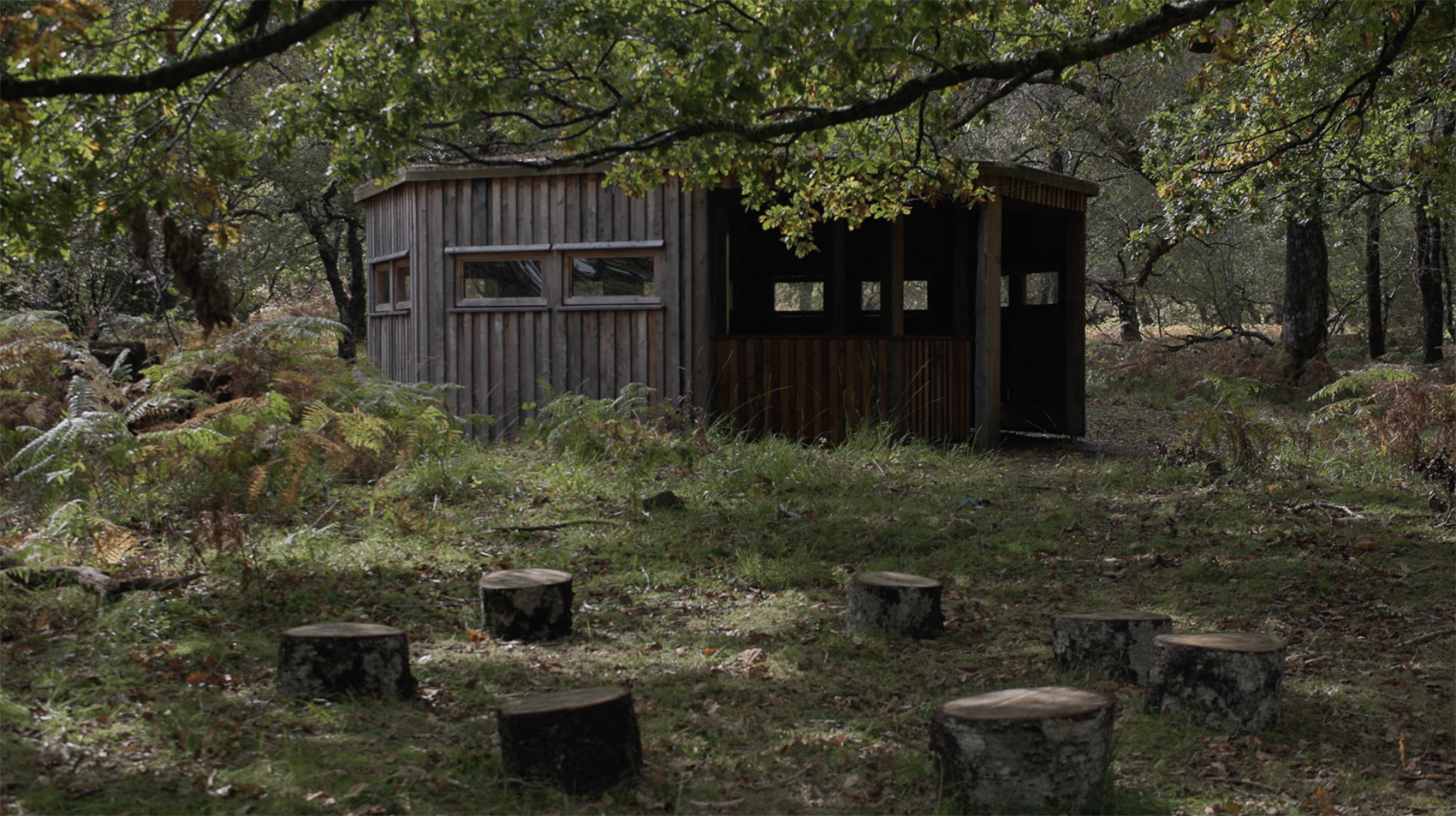
Smart Forests film showing Bosque Pehuén conservation area. La Araucanía, Chile. Jennifer Gabrys with Smart Forests, 2023.