
FIRE NETWORKS
Fire Networks
Smart Forests and Fundación Mar Adentro
Ecologies and societies take shape together. Planetary dynamics influence social life, which in turn transforms environments. Fire networks are increasingly materializing as a distinct form of social organization in response to environmental risk. “Fire networks” is a term, concept and strategy for describing how community actors, government agencies, civil society organizations, researchers, and Indigenous groups variously manage, collaborate, and respond to fire events across a full fire lifecycle within changing landscapes. Community and governmental initiatives develop to prevent fires from occurring, while civic groups build infrastructures to respond to fires when they ignite. Education and sustainability networks provide resources and information for understanding fire ecologies and events, while conservation researchers and foundations collaborate to regenerate landscapes after the effects of fires. Fire is transforming societies. In turn, societies are attempting to remake relationships with fire and environments.
As noted in the introduction to this collection, environmental hazards have shaped not just Chile’s geology but also its social worlds, where community networks, environmental agencies, and government units have formed in response to earthquakes, tsunamis, and volcanoes. By anticipating and preparing, as well as responding to and recovering from disasters, social networks materialize alongside territorial events. Practices of anticipating and preparing, responding and recovering, create distinct social-ecological relations. Some social assemblages are well established in response to environmental disasters. Others, such as fire, are still emerging in terms of the community infrastructures needed to prepare for and respond to them. At the same time, fire is more than a disaster—it can also be a biocultural process, a way of cultivating landscapes, and an integral part of how some landscapes renew and regenerate. Although some insights about social organization related to disasters could be transferable to fires, others might need to be generated through ongoing relationships with landscapes and projections about how they could change.
This chapter on “Fire Networks,” along with the following two chapters on “Fire Technologies” and “Fire Practices,” present synthesized findings from the Field Schools, interviews, and fieldwork, and art-science residencies undertaken as part of the Ecologies of Fire collaboration across the Smart Forests project and Fundación Mar Adentro. Alongside the arts-sciences residencies, we interviewed community groups set up to prevent and respond to fire events, as well as government workers and academic researchers creating infrastructures and resources to address increasing fire risk. We also held three Field Schools in Bosque Pehuén, Temuco, and Pucón in La Araucanía in 2024, during which multiple participants generated ideas, plans, and actions to address increasing wildfire risk in Chile. Fire professionals from CONAF, environmental educators, community leaders, and environmental foundations came together to propose actions and guidelines for community fire plans. The objective of these Field Schools was to gather diverse perspectives to explore how local, community, and ancestral knowledge, along with expert techniques and environmental governance, can connect to create more collaborative and effective approaches to environmental change. We documented the current state of fire networks, practices, and technologies, and collectively explored how they could be advanced to achieve greater effectiveness and fairness.
Fire prevention and emergency management in Chile extends to a wide range of actors and tools. In the process of this collaboration, we learned about multiple fire networks that had developed over time or were newly emerging. SENAPRED (the National Disaster Prevention and Response Service) plays a central coordinating role, bringing together key stakeholders, including municipal governments and CONAF (the National Forest Corporation). Expert-driven and governmental directives can connect fire agencies, but sometimes have fewer interactions with community groups. Other fire networks are grassroots and community-driven, tied to local territories and addressing site-specific concerns. Community fire prevention networks collaborate with neighborhood associations to support the implementation of fire prevention plans and emergency responses. University research projects, community infrastructures, foundation initiatives, sustainability movements, and industry resources also intersect with and form fire networks in multiple ways.
As a central actor within fire networks, CONAF has established a community fire prevention methodology, created in 2015 and updated in 2022.CONAF, «Metodología para la elaboración de planes comunitarios de prevención de incendios forestales». While this is as much a practice as a network, CONAF’s template requires community involvement to be effective. Consisting of eight parts, the fire-prevention methodology works toward a standardized and achievable “fire-ready community project,” especially at the forest-urban interface, and involves activating community groups by creating fire plans and actions for specific territories. We further discuss CONAF’s outlined prevention practices in the upcoming chapter on “Fire Practices.” However, of note are the distinct actors and interactions that CONAF’s methodology identifies as central to the project of fire prevention. They also suggest bringing together national and regional CONAF prevention managers, local community representatives, local fire department representatives, and regional CONAF support professionals. As our interviews and workshops indicate, however, there are often insufficient financial and human resources for this level of CONAF involvement in what can be labor-intensive networks, workshops, and processes that would have to engage with numerous and diverse communities. In our interactions with fire and land managers, there was a sense that community participation in fire prevention could be more robust but would be difficult to sustain due to limited resources and the burden on communities of dealing with fire.

CONAF’s manual, “Methodology for Developing Community Forest Fire Prevention Plans.” Jennifer Gabrys, 2024.

CONAF mobile command post at Boldo 1 headquarters, Temuco. Jennifer Gabrys, 2024.
The latest version of CONAF’s “fire-ready community project” handbook suggests undertaking a “community diagnosis” to identify relevant actors and connect to existing land-use planning and fire-prevention strategies in the area. CONAF’s understanding of community is tied to a common territory.CONAF, «Metodología», 19. However, with increasing levels of tourism and second-home ownership, communities can also take more distributed and multi-located forms. Community members also often have collective memories of fires in their territories, which might not have been documented by CONAF but can be useful for understanding fire patterns. In addition to distinct actors, it is possible to create forums to bring people together for cooperation and collaboration, from community councils that can lead workshops and promote fire prevention strategies, to educational initiatives, and eco-cultural events. In addition to formulating fire-prevention plans, these networks can educate and raise awareness, identify and execute projects to enhance fire readiness, and encourage people and communities living in fire zones to prepare and take responsibility for fire events.
Localized strategies, community leadership, and place-based cooperation
In Chile, as many as 99 percent of forest fires are caused by human action, whether through negligence or intention.CONAF, «Metodología». However, within mountainous regions such as La Araucanía, lightning strikes can contribute to 20 percent of fire ignition, as our conversations with CONAF personnel suggested. Community testimony has also shown that fires can start when trees falling onto power lines. For these reasons, there is considerable emphasis on communities as key actors in preventing and preparing for fires. As many fire agencies, researchers, and practitioners have noted, localized strategies are essential for building resilient communities. The development of community emergency plans, risk governance processes, and robust communication channels is key to ensuring effective coordination across multiple local actors and agencies.
Alongside CONAF’s community-led fire prevention methodology, there are local government, community-led, and conservation foundation initiatives for addressing fire, including Altos de Cantillana, Ecobrigada Chukaw Mahuida, Caritas Chile, Arca Sur, and Águila Sur, among others. These groups have developed approaches to community fire prevention, response, conservation, and regeneration that focus on local risk education, community-level processes, local training, community emergency organization, and local committees and actions. Successful collaborations within and beyond local territories—such as those underway in Villarrica National Park or between Pucón firefighters and municipal authorities—demonstrate the power of place-based cooperation. Land managers, local businesses, and public-private partnerships can further enhance fire adaptability and network effectiveness.


Temuco Field School session on fire practices, networks, and technologies. Jennifer Gabrys, 2024.
It is notable that fire prevention practices are often designed to be “community-led.” Nevertheless, there are still many questions and opportunities for learning about what is required for a community to lead in responding to fire prevention, who should be involved in these efforts, what the required commitments are, how learning is shared, how communications are undertaken, and how a community-led fire prevention network can ensure it is effective in its efforts over time. As three participants in our Temuco-based Field School each noted:
“Regarding networks, we believe it is important for communities to be represented when decisions are made, because it is said that they are usually consulted, but when it comes to decision-making, there is no consideration given to connecting the community with the institutions that promote fire prevention, forming working teams, and considering how to communicate with all stakeholders and with regard to technology.”
“We conclude that any plan must be developed collaboratively, not at the expert level, but always with the people. And this goes hand in hand with governance in the territories; there must also be governance.”
“It seems to me that everyone works thinking about the community, so that it is protected, strengthened, and so on. But at no time and in no instance where decisions are made does the community participate. It seems as if everyone represents it. So, I think it has its own voice and that it should be represented […].”Group discussions at Smart Forests Field School, Temuco (April 2024).
Co-construction of fire-prevention plans is by now an often-heard phrase. Here, participants point to several aspects of what they feel should happen in this co-construction: to go beyond consultation, to include communities as equal contributors in the process, and to recognize and activate the day-to-day knowledge and interaction that communities have with their territories. Furthermore, a certain level of trust and integrity is needed when building community fire networks to allow people to collectively prepare for and respond to emergency events that can have high levels of uncertainty and require flexible coordination. For these reasons, co-construction requires genuine dialogue in making and implementing fire governance plans—and actions.
Cultivating fire networks
As many people noted in Field School discussions and fieldwork interviews, fire is often addressed as a problem of responsiveness. When fires ignite, the time spans to response and suppression are crucial. While this is often seen as a problem for fire agencies and their crews, many community fire brigades, such as Águila Sur and Ecobrigada Chukaw Mahuida, have formed to address this. Yet as these organizations and Field School participants noted, a primary focus on responsiveness can overlook many other components of fire ecologies. For this reason, fire prevention has become more central to forestall fires igniting, and with this change in focus, community engagement has become even more essential. As the UNEP report, Spreading Like Wildfire, notes, 50 percent of resources worldwide are spent on combatting fires, while only 1 percent are directed to prevention. The authors of this report propose reprioritizing resources toward preparation and prevention to reduce fire risk, while continuing to support emergency workers and firefighters.UNEP, Spreading Like Wildfire; UNEP, “Number of Wildfires to Rise by 50 Percent by 2100.”
With this shift to community-led fire prevention practices, fire ecologies open into more expansive social relations and modes of engaging with fire dynamics. These initiatives tend to be in more direct and ongoing contact with community projects. From education and restoration to communication and plurinational coordination, networks are developing to increase fire knowledge, share community mobilizing techniques and resources, build infrastructures, create educational programs for listening to the land, and work across sectors to ensure democratic and fair approaches to ongoing environmental change.
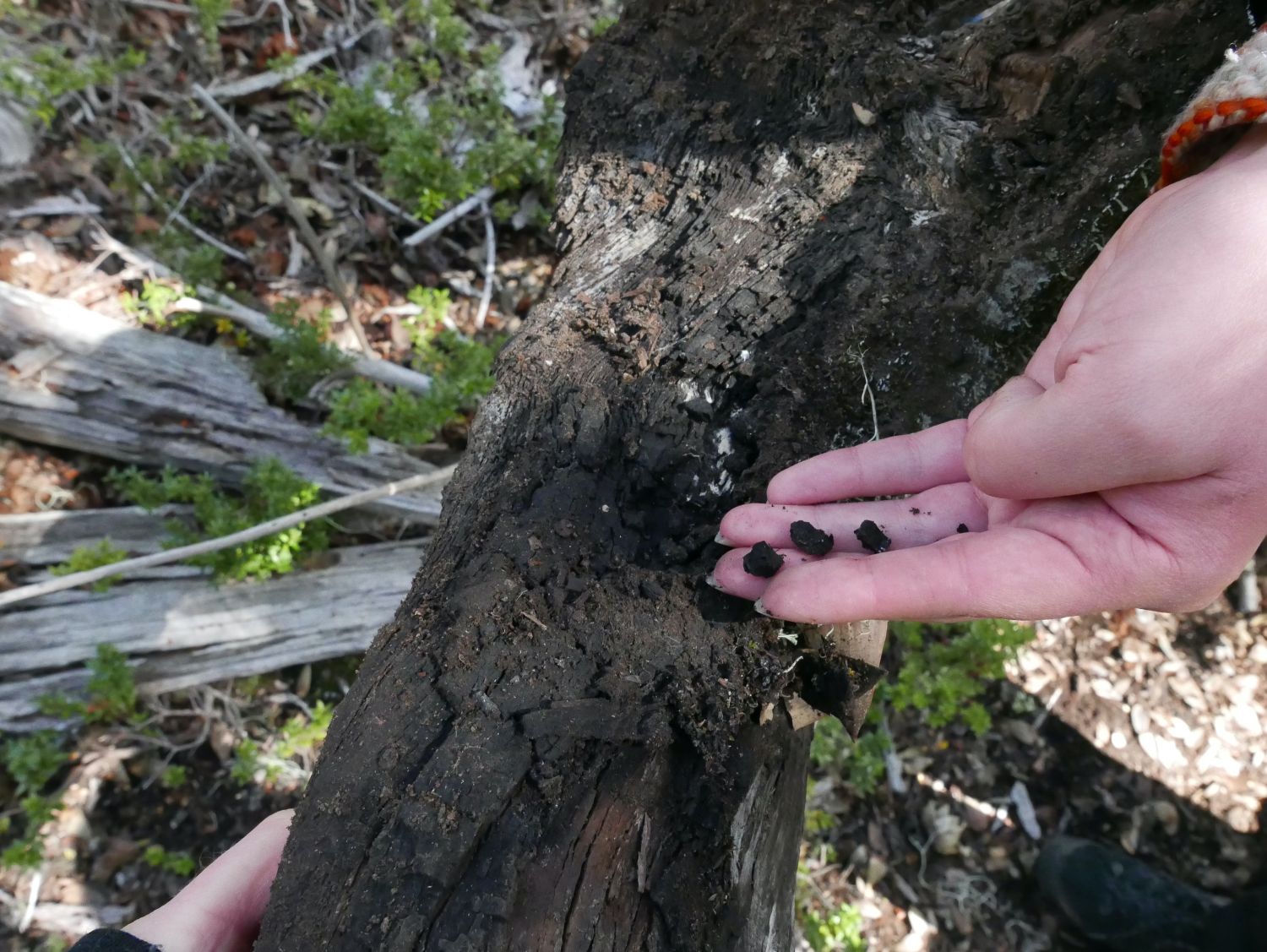
Field School and walk investigating fire residue at Bosque Pehuén. Jennifer Gabrys, 2024.
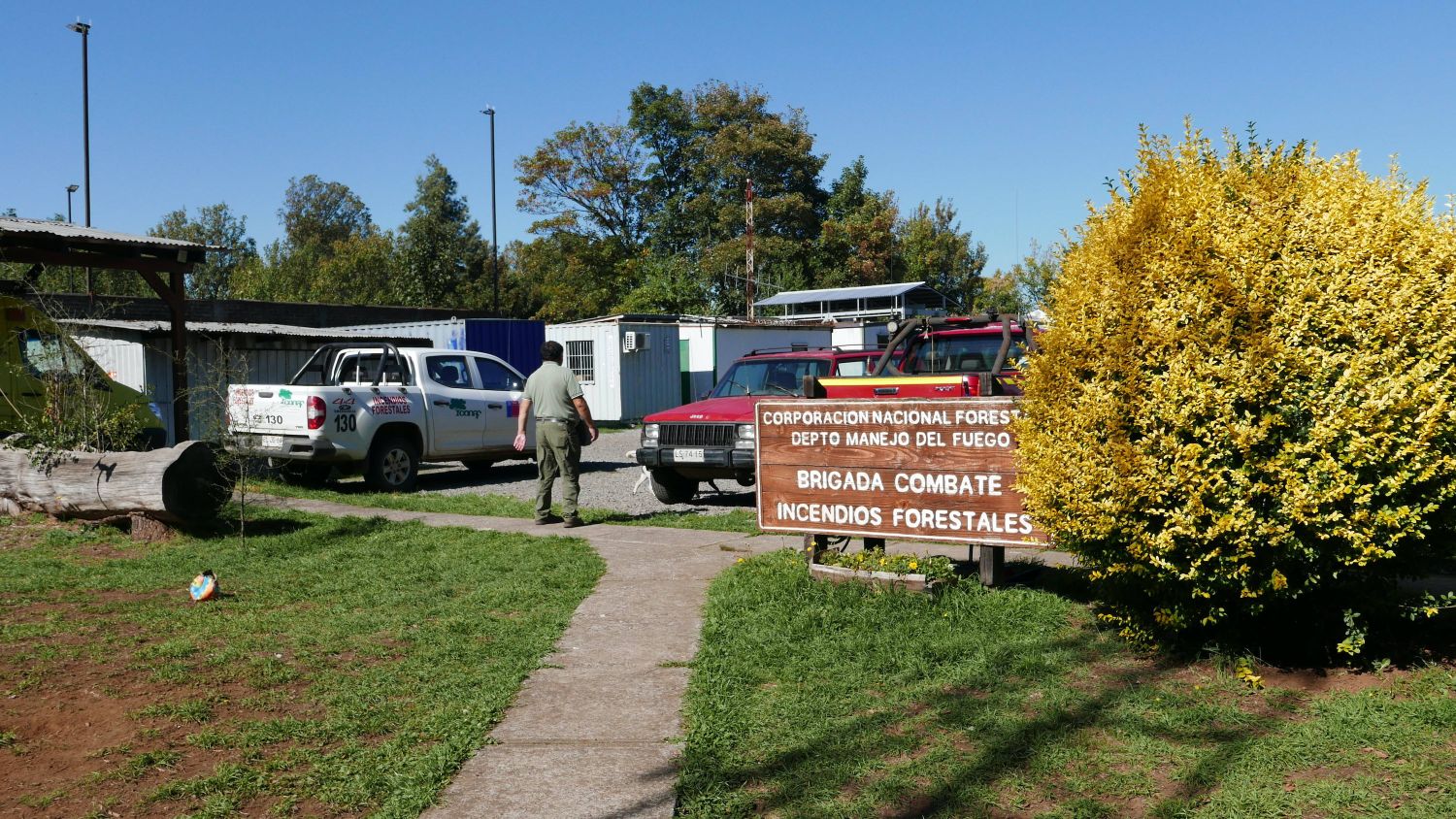
CONAF Boldo 1 headquarters, Temuco. Jennifer Gabrys, 2024.
The purpose of fire networks is a key component of how they form and are sustained. There are many different networks for fire prevention in Chile, some of which extend across the fire cycle. Some networks are principally engaged with prevention, while others include elements of fire response and suppression, education, conservation, and restoration. Other networks work across all these components, incorporating education in every aspect of addressing fire-prone environments and how an informed community can respond to these dynamics.
Fire is now a constant reality in 21st-century environments worldwide. Integrating fire preparedness into social networks is necessary to engage with ecological dynamics amid significant change and disruption. As Temuco Field School participants noted, such ongoing integration could include regular communication and fire network meetings to encourage shared learning, as well as wider regional and national initiatives to create fire education and training within schools, communities, national parks, and at-risk environments. These fire networks sometimes join up to identify opportunities for mutual learning and to extend fire knowledge across fire lifecycles. In this sense, fire networks spark processes for making and transforming social worlds. However, what is at times missing are networks that connect beyond territories and regions, enabling local community initiatives to engage in mutual learning opportunities from their own territorial perspective. While this could include national coordination, local initiatives also require channels for communication to improve and advance grassroots practices through cross-fertilization.
As identified by Field School participants, more established networks for fire education are also missing. Many participants commented that stronger connections could be built across governmental organizations, research centers, and communities, to ensure ongoing education and to reinforce community learning and resilience at all stages of fire events. Universities, foundations, and research centers can contribute valuable knowledge while helping to bridge gaps between science, policy, and practice. Schools and universities can also be core institutions for outreach and coordination, contributing to environmental certification processes, facilitating municipal partnership programs, and contributing to disaster response and recovery strategies. Existing initiatives, such as territorial planning labs, can serve as models for integrating academic expertise into practice and enhancing collective preparedness and response capacities.
If we return to the opening section of this chapter, we can see that diverse and different networks are materializing in response to wildfires. In many cases, these networks are responding to ongoing and emerging social-ecological challenges and demands in changing environments. If there is a prevailing theme for how these networks are taking shape in La Araucanía, Chile, we could say, based on the research undertaken here, that local initiatives are often the starting point for many fire networks. Community groups, local organizations, territorial agencies, Indigenous groups, residents, property owners, brigadistas, and municipalities are interacting—and in some cases cooperating—to address distinct territorial conditions and fire histories. Because these groups are closest to the territories where fires start, they often have the most detailed, long-standing, and immediate knowledge of what happens in these locations, and are best placed to respond first while also ensuring the longevity and sustainability of territorial practices. At the same time, it is vital that these groups connect with regional, national and international actors and resources, including SENAPRED, CONAF, bomberos, carabineros, universities and educational centers, civil society organizations and NGOs, as well as forestry companies and technology companies, to develop effective and informed land planning, management, and action.
Fire networks pose the question not just of social organization, but also of governance. As Villarrica Park Ranger Felipe Ortega notes:
“I would say that the most important thing right now is to advance governance so that the National Park makes decisions about its activities in conjunction with the public, with a special emphasis on the Mapuche communities, given that they have customary use […]. And to strengthen alliances with local organizations and ensure that all decision-making always goes through participatory processes. I think we need to invite people to experience conservation, to understand that we are conserving for ourselves, right?”
To build the most robust knowledge, relations, and networks, it is necessary to engage in ongoing dialogue and mutual learning about the growing environmental risk of wildfires in Chile, and the possibilities for responding to them. This will require active community involvement to build capacity and manage wildfire risk while coordinating with and across municipalities, CONAF, SENAPRED, disaster risk management teams, and other agencies. It will also require ensuring adequate resources are available to set up and sustain community fire networks for long-term viability across fire lifecycles, from prevention to response, regeneration, and conservation.
There is no single ideal model for fire networks. Instead, in our research we found plural and dynamic practices grounded in local conditions and linked to regional and national coordination. Fire networks have formed to respond to fire events and to address broader ecological cycles of prevention, regeneration, and conservation that define fire-affected landscapes. Given the scale and scope of planetary change, community-led fire networks can be pivotal in achieving effective and shared environmental governance.

Intercultural Planning
with Communities
and Ecosystems
Felipe Ortega and Smart Forests
Felipe Ortega is a biologist specializing in territorial planning and management. He has an interest in the relationships between human well-being and nature, and intercultural engagements with society and nature. In this interview with Jennifer Gabrys, Pablo González Rivas, and Paula Tiara Torres from the Smart Forests project, Felipe describes the conservation work that CONAF undertakes in the Villarrica National Park. He outlines efforts in conservation education, intercultural territorial planning, and community engagement to ensure effective responses to environmental events such as wildfires.
Smart Forests (SF): To begin with, we would like to hear how you came to work as a park ranger in Villarrica National Park.
Felipe Ortega (FO): I am a nature lover and, whenever I can, I visit and discover new places. After finishing my studies at university, I joined CONAF because at that time I was involved in the planning of protected wilderness areas. In that role, I implemented several management plans, an essential tool for the administration of protected areas, which is the very core of conservation work in the Araucanía region. After that, I worked in territorial planning, drawing up land-use plans for several regions of Chile. Around 2009-2010, I began to get a little closer to what I do today in the National Park, working on public use plans, and around 2014-2015, I was tasked with creating a protected area in Patagonia called Parque La Tapera, a private protected area where I established the baselines for the site and the guidelines that led to its transformation into a protected area. After that, there was a public competition for park rangers at Villarrica National Park, which I applied for and won, and in 2017 I joined the team of park rangers at Villarrica National Park. I have been working on issues of environmental education, inclusion, governance, conservation monitoring, and in 2024 I took on the role of park administrator.
SF: And, within the conservation monitoring and environmental education programs you have developed, do you also address issues related to community forest fire management and community work?
FO: Yes, we work with a method called open standards, which is a method that first looks at what your conservation priorities are, both biological and cultural, and then looks at what threats there are to those conservation priorities. From there, you develop conservation strategies. These strategies include conservation education. Therefore, we have set up park ranger schools for children, we also give various talks to visitors to the park, and we go to schools to give these talks. Another strategy we have is monitoring these conservation priorities. We have a standardized methodology, which is camera trapping, mainly used for carnivores and small mammals. We also have a comprehensive wetland bird monitoring program, which has been running for over 20 years. We also have a systematic monitoring system for black woodpeckers, which are quite active in the forest. This has been a very important issue since I arrived, giving weight to everything that has to do with participation and moving from a more consultative, informative role to addressing decision-making within the National Park together with actors that are located near our unit. In Pucón, we have made significant progress on governance issues to protect the sacred ceremonial sites of the Mapuche communities here in the territory. Finally, the threat that runs through almost all of these efforts is wildfires. We work with CONAF's Forest Fire Prevention Department and also carry out several activities in schools to inform the community about the risk of forest fires. In addition, some time ago we collaborated with the Sustenta Pucón Foundation in the development of a manual on how to live on rural plots, which includes guidelines for wildfire fire prevention.
SF: On this last point, regarding collaboration experiences, with which organizations or institutions do you maintain connections? And how important are these networks for the creation or implementation of the work you do in conservation?
FO: When we create stakeholder maps, we distinguish between Mapuche and non-Mapuche communities around the park. We work with the Curarrehue Association, which is an important organization in the area, representing around 15 communities in the sector. We have been working with them for many years on the protection of the araucaria tree, the territory, its waters, and the celebration of the wetlands. We also work with organizations from the Mapuche communities of Pucón and Villarrica, specifically on issues related to the protection of ceremonial sites within the park. In addition, we work with universities, supporting field research processes. We have also collaborated with the Fundación Mar Adentro and its residency program. We also work with Pro Pucón, a private corporation, on issues of inclusion.
SF: And how do you invite these organizations, communities or institutions to collaborate?
FO: I would say that Villarrica National Park is the most important territorial coordinator in the entire area due to its geographical location and protected status. Not only does it provide a series of ecosystem services that permeate the two most important watersheds in the Araucanía and Los Ríos regions, but it also serves as a meeting point for the communities that surround it. Regarding the araucaria trees in the park, we also provide protection for the araucaria and the piñón [the araucaria nut], so most of the institutions, in one way or another, are related to this place in their management. In terms of tourism, one of the main attractions in the area of Villarrica National Park. Now, in terms of natural hazards, we have the most active volcano in Chile, which is also highly visited by tourists. We are coordinating with different organizations on how to be prepared for an eruption.
SF: Considering the park as a social and geographical hub, how do you see natural disaster risk management relating to the park's governance plans and your role as park rangers?
FO: People see park rangers as a valuable source of information. They ask us a lot about burning permits, for example, or what to do with pruning debris. We visit many of the residents regularly, and many of them earn income from tourism, but we always ask them to be careful with fire, to protect their campsites and other areas, and to have prevention plans in place. Especially with the Mapuche communities, they use fire in their ceremonies, and what we do is support them so that they can carry out their ceremonies as they should within the National Park or the surrounding area. We give them a vote of confidence regarding the use of fire.
SF: Who do you think still needs to participate in this network?
FO: I think neighborhood associations are an important stakeholder, and they don't have much of a relationship with us. These are groups we should be reaching out to much more.
SF: In relation to fire history in this territory, could you tell us about any fires that have occurred in the park and the associated monitoring and control efforts?
FO: We haven't had any major fires for years. The last fire was caused by lightning strikes, which we were able to reach quickly with our team. We use a tool called SMART, which is software designed to monitor threats. So, we patrol and enter information into this software, for example, if we find unattended campfires or people making fires. This information is entered into the platform and georeferenced statistics are obtained for the places with the greatest threats, thus identifying the points where fire-related threats are concentrated.
SF: And what technologies do you use for communication and alerts in emergency situations?
FO: We use mobile phones when we have a signal. There is a WhatsApp group that acts as a monitoring information center, and we use radios in blind spots where there is no phone coverage. I would say those two elements are the most important. We also subscribe to a NASA channel that alerts us to temperature changes in the territory.
SF: How is that information disseminated to the surrounding communities?
FO: The SAE system [Emergency Alert System in Chile] should work in the event of a forest fire, informing them when to evacuate.
SF: Is there a type of technology you use for park conservation that you consider particularly noteworthy?
FO: The use of camera traps is undoubtedly the most important piece of technology we are working with. This allows us to see species that are difficult to spot, such as guiñas, pudus, or pumas. We also use drones, which allow us to carry out phonological monitoring of some plant species in the face of climate change.
SF: Do you think these technological practices are practices that can also be applied in other contexts? In other words, can they be applied by non-experts?
FO: Yes, we have started a system of using camera traps with schoolchildren and also with Mapuche communities, thinking that in the future we could have co-management with them and the idea is that they use the same techniques that we use for monitoring. We also use social media as a means of communication for some of the elements we work on in the park.
SF: Yes, I have seen more than one video of you explaining elements of conservation or about a particular species, from small insects to larger species.
FO: Protected areas are always in a delicate balance, which is often disrupted by human actions. Nature works perfectly, but when we remove a link in the chain, we can cause significant disturbances. Therefore, every element of a protected area is essential. We are often unaware of the impact of something as small as a campfire, which can burn ant eggs or use wood that, as it decomposes, provides nutrients to the soil or serves as a hiding place for frogs. So, sometimes, as exaggerated as it may seem, protected areas fulfil this role and it is the duty of all of us to protect and care for every element within a natural area.
SF: Along those lines, what are the next steps for your work as a park ranger in Villarrica National Park in terms of conservation, environmental education, and forest fires?
FO: I would say that at this moment, the most important thing is to advance in governance, so that the National Park makes decisions regarding its work in conjunction with the public, with special emphasis on the Mapuche communities, given that they have customary use. We must strengthen alliances with local organizations and ensure that decision-making always involves participatory processes that invite people to live conservation, to understand that we conserve for ourselves. Therefore, we have to improve communication channels and adequate infrastructure so that we can come together, as well as learn much more about interculturality. We should also use clear language in our talks, inspiring visitors about nature, and encouraging more teachers and students to visit the park. I think that is the main challenge regarding wildfires. We must also make progress in improving infrastructure, such as building heliports for a faster response to fires.
SF: How do you expect this work to address climate change through the use of technology or other policies and implementations?
FO: On the one hand, creating more forests. We are restoring or helping nature a little in areas where we have intervened by creating new forests and promoting the natural regeneration of native forests. On the other hand, we are working hard on everything related to fire prevention, and we need to join forces in terms of prevention, education, and infrastructure. I am also very interested in everything related to community forest fire prevention plans. We would like to be involved in these plans, not leading, but participating, to find out how the community is doing, how prepared it is, how we can help, and how we, as state institutions, can provide support and information. We need people to better value the ecosystem services provided by the National Park and how they affect them. I think this is key for them to take better care of it and to feel proud of the beautiful national park they have.

The Forest Fire
as a Planetarium:
A Prophetic Game
Bárbara Acevedo Strange
During the residency in Bosque Pehuén, our days turn into routines of fire: first comes the heat, and shortly after, the food that nourishes our bodies and provides energy for our various investigations. It is the fireplace where we gather that makes evident the interrelationship between the different oikoi (homes) we embark upon. It helps us navigate the different dimensions that compose the reality in which we live.
This relational quality of fire inspires the starting point of my project, which aims to create a repository of narrative tools for post-apocalyptic world-building. Throughout the residency at Bosque Pehuén, the collection grew through observations of post-fire responses within the landscape. The language used to describe such phenomena resonates through the collection, which takes the shape of a game.
The game proposes a space for cosmopolitan storytelling. Each component can be stacked and layered, creating new entanglements. Fire here plays the role of a vector; it mobilizes material and possesses transformative faculties. While looking at the shadows, the players are asked to set themselves in relation to the world they find in front of them. The game poses the question of the aftermath of the catastrophe using a non-anthropocentric vocabulary.

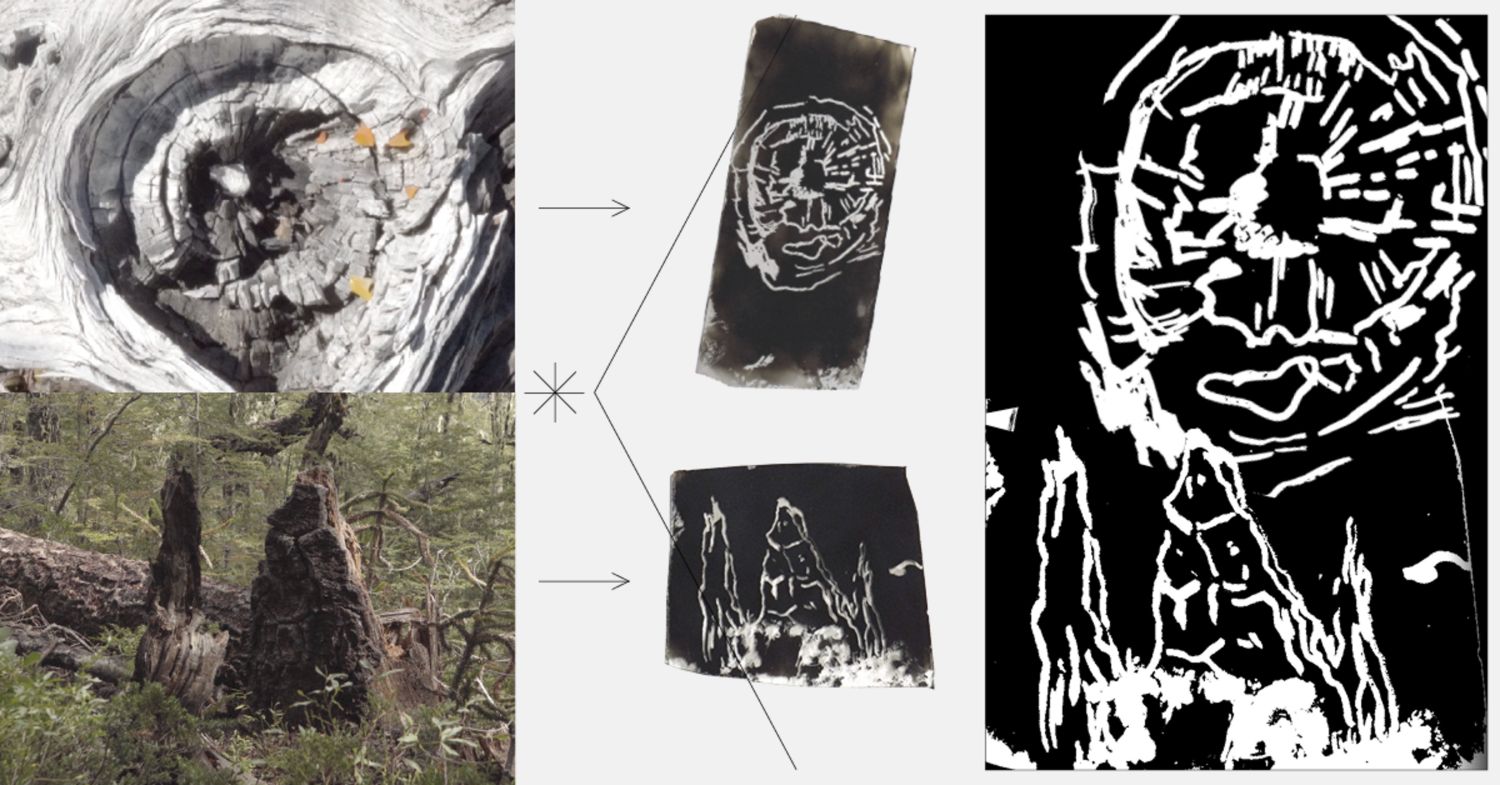
Creative process behind the design of “The Forest Fire as Planetarium: A Prophetic Game” created during the Bosque Pehuén – Ecologies of Fire. Bárbara Acevedo Strange, 2024.
On 12 November 2024, this game was played during the second Field School implemented in the Universidad La Frontera–Pucón Campus. Participants were grouped into teams of up to five people, where they approached a table and were confronted with all of the playing cards. Based on a question they would find on their assigned table, each participant was asked to choose three cards, hence three words and symbols. They then had the task to first answer the question using the three chosen words, and then, as a group, decide how to bring together into a collective narrative the diverse range of responses. Below are some of the resulting answers to the following questions:
What does the lizard imagine when fire approaches?
What does the araucaria (monkey puzzle tree) think when it senses the inevitable approach of fire?
What does the quila (Chilean bamboo) perceive after the fire passes?
dead standing ruin regrowth
After the fire, I was standing dead, a total ruin — but time passes and I am regrowing. After disaster, seeing the positive is the source and inspiration for strength.
habitat sore scale
The flowering quila announces the coming fire, habitat of the snake, in its scales, sores form.
scar seed succession
The fire advances and leaves me with a scar, activating the seed of life to begin the forest succession.
flow regrowth seed
The lizard, guardian of the forest, feels that once the fire completes its cycle and the sphere ends, the forest will flow and life will regrow, generating a new seed.
volcano crater habitat
Its foundations rest on an ancient volcano that shaped its geography over time. Its crater was transformed to give rise to fragile lagoons, reserves of water and life, habitat to countless species and beings that welcome us with their kindness.
lightning wound adaptation
The heat is scorching; it feels like there have been thousands of lightning bolts. A wound opens and I feel fear and sadness. In the silence after the fire, I read a message of hope in the clouds: transmutation towards adaptation.
decompose seed succession
The araucaria knows that if it will decompose if fire reaches it, but that its seeds will allow the succession of its species.
acceleration sun dry
Is it the sun I see? Although I feel that its rhythm and acceleration are somewhat different... I hope I don't experience what I see in the plants drying up around me.

Installation by Bárbara Acevedo Strange, created for the public program of the Bosque Pehuén–Ecologies of Fire residencies, at Casa Varas, a cultural center in Temuco, La Araucanía, April 2024. A shadow play with glass and symbols inspired by fire, created in ash over fire, which later inspired the creation of “The Forest Fire as a Planetarium: A Prophetic Game.” Maya Errázuriz.
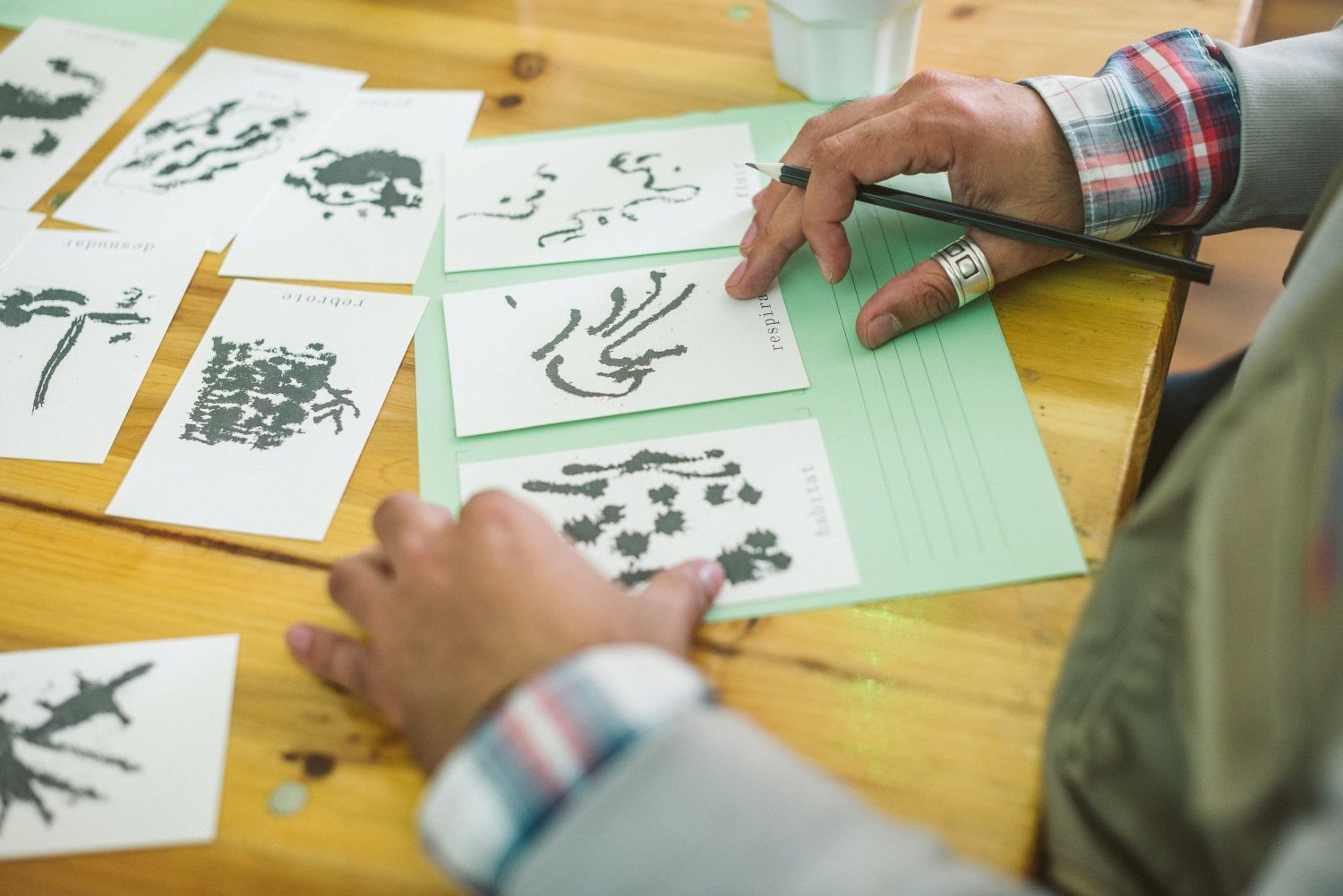
During one of the field schools organized by Smart Forests and the Mar Adentro Foundation at UFRO–Pucón Campus, November 2024. Participants played Bárbara Acevedo’s planetarium game, in which they divided into groups to answer questions that invited reflection on fire. Josefina Astorga for Smart Forests.
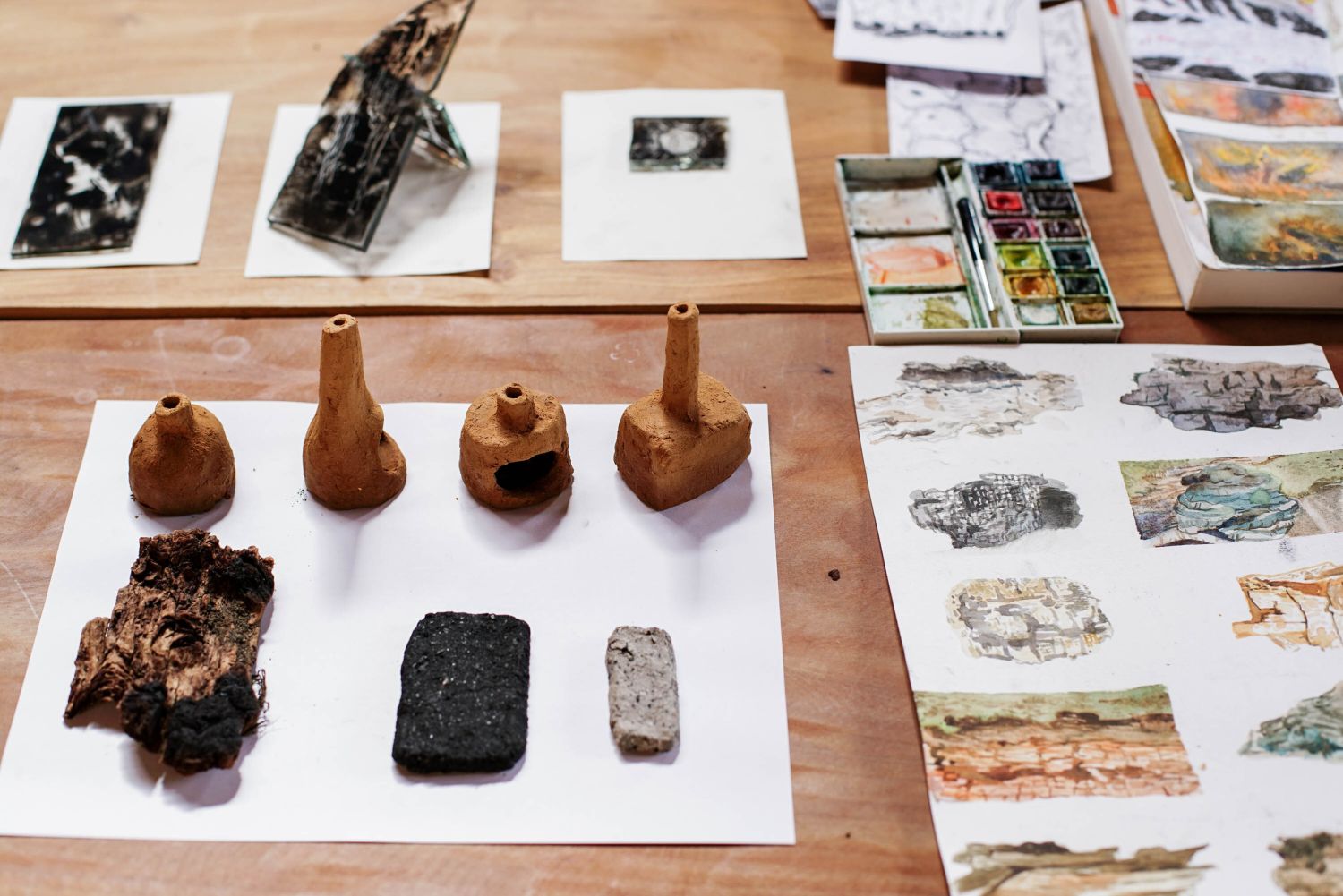
Process research that led to the design of “The Forest Fire as Planetarium: A Prophetic Game” by Bárbara Acevedo Strange, created during her time in the forest at Bosque Pehuén–Ecologies of Fire residency. Andrea Novoa, 2024.